Spatial capture → walkable world
A phone scan becomes solid geometry in about ten seconds.
Physical intelligence infrastructure2026
SOPHIA gives every operator, agent and machine one persistent, live understanding of a physical site.
Cameras, robots and agents already exist. What they lack is a persistent reality they can all inspect, update and act on.
They do not preserve shared context.
Each machine rebuilds the same place.
They cannot inspect persistent live state.
Commodity inputs became geometry, shared tracks, memory and policy-gated action. The interface below is the system itself.
A phone scan becomes solid geometry in about ten seconds.
Camera and low-cost radar resolve into one live person track.
Measure a route, reason over the site and trigger a spoken action.
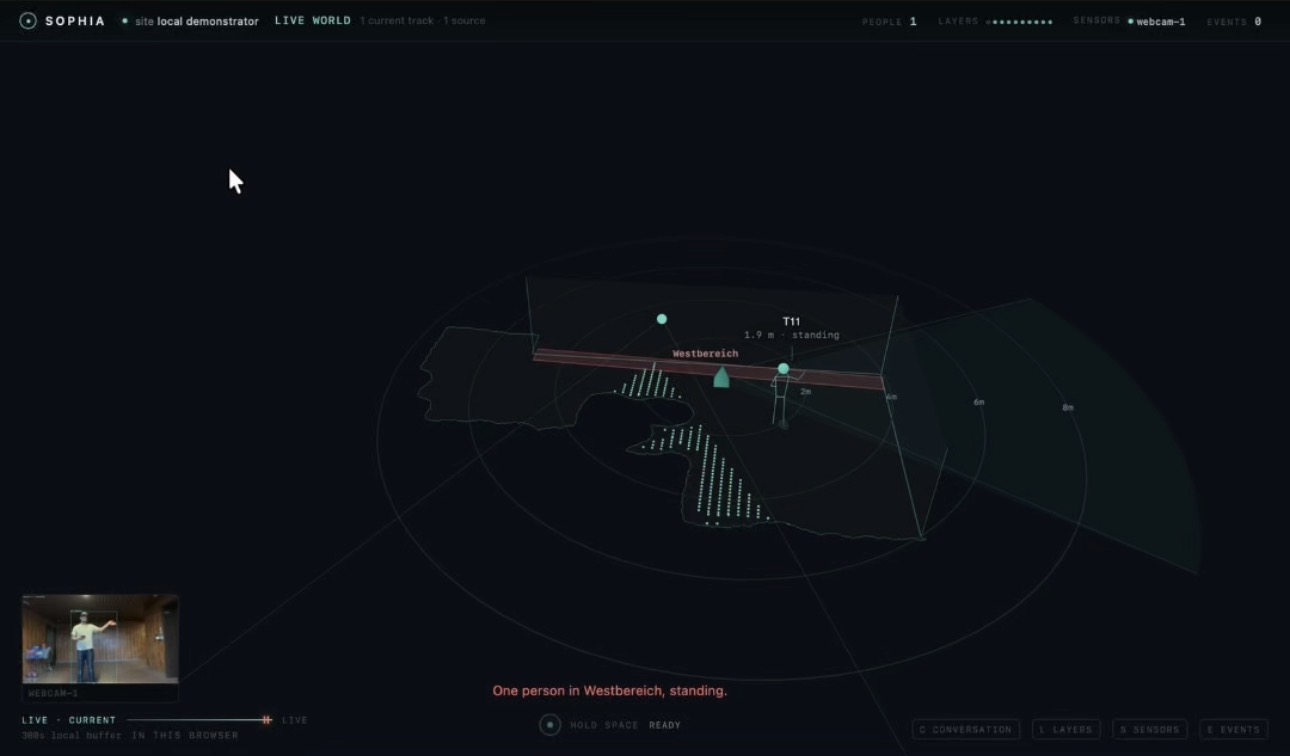
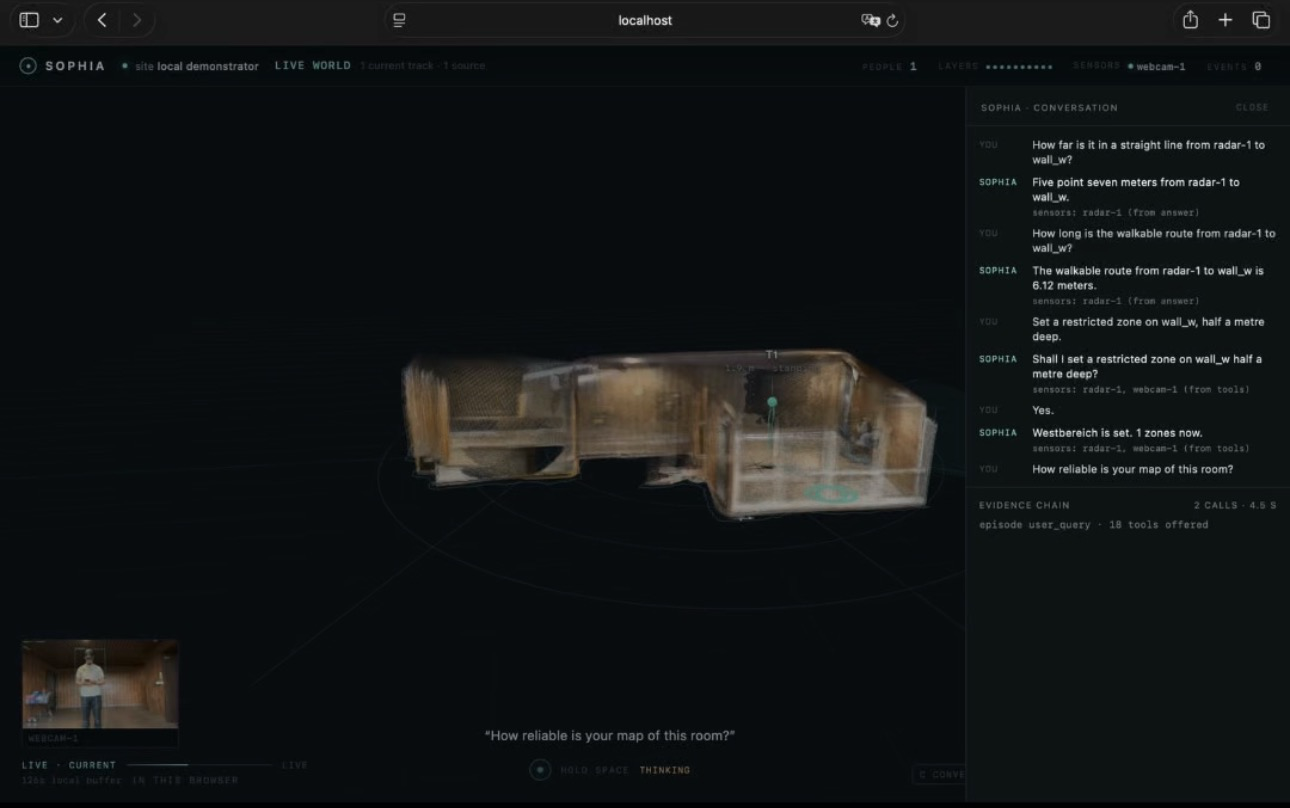
SOPHIA turns fragmented observations into one continuously usable state layer for people, software and machines.
Sensors
SOPHIA world model
World primitives
Clients
typed contracts · registry · frame graph · replay
LIVE DEMOworld model · fusion · voice · actions
Security first
Security is the first deployment because the buyer, budget and operational pain already exist. A live world can be tested against concrete events, permissions and response times.
Win one urgent workflow.
Install one persistent site world.
Let every later client reuse it.
Security funds the first site. Every new machine expands the same world.
One installed world can support new missions without remapping the site or rebuilding context for every sensor, team or machine.
A live mission world for fire, rescue and disaster response.
Two indoor drones enter a smoke-filled, GPS-denied building. LiDAR, thermal and gas observations build an evidence-backed search state from unknown to mapped to searched, while possible victims, hazards and responder positions remain visible to incident command.
Indoor drones + responders → room / hazard / search state → command + safe routing
Presence, fall events and clinical telemetry in spatial context.
Radar detects a floor-level presence while an authorized wearable reports abnormal telemetry. SOPHIA binds both signals to the person and room, then routes the nearest caregiver with the exact location and evidence.
Radar + authorized device → person / room / vital context → caregiver response
Live people, machines and permissions inside one operating state.
A person enters a live machine cell. SOPHIA fuses camera, radar and machine state, resolves the restricted-zone event and issues a policy-gated alert or stop.
Person + machine → shared zone state → operator action
Persistent assets, access state and change history across a real site.
A technician asks where the affected pump is and for the safest authorized route. SOPHIA returns the asset, current obstacles, access state and prior observations as one grounded task context.
Asset + live access state → grounded route / context → maintenance action
Maps, memory and coordination that survive device boundaries.
One AMR finds a blocked aisle. SOPHIA updates the shared world once, so every robot and planning agent inherits the same obstruction and reroutes.
Robot observation → shared obstruction → fleet reroute
A persistent asset world before, during and after every mission.
An inspection drone finds damage on a roof asset. SOPHIA anchors the finding to the site model, preserves it in memory and gives the next mission the same target for verified change detection.
Aerial scan → asset-linked condition → follow-up mission
A truck arrives while people, an AMR and an automated door share the same zone. SOPHIA holds occupancy, permissions and intent so the door opens only when the bay is clear and the robot moves only when route and policy agree.
Truck + people + doors + AMR → one operating picture → coordinated action
From typed contracts to a working live world.
Inside the first site and close to its operators.
Leon Karim Valentin, 19, built SOPHIA's working core solo in five weeks—across software, hardware and the physical site itself.
The first building is not a staged lab. Leon grew up inside it. That access created a direct loop between real operators, real constraints and the system being built.
For investors, design partners and builders